Extractions and Transcription Forms
Using forms will help you copy the information accurately and completely as well as guide you in interpreting it later.
Census records (1880-1940)
Census records 1880-1940 name everyone in household and specify relation of each person to the head of household.
- 1940 Census Questions and Information
-- notice that on top of page is a link to a census extraction form.
- The 1940 census was released in 2012 and was indexed as quickly as possible. There were three different indeing projects:
- The 1940 Census Community project -- FamilySearch, Archives.com, Censusrecords.com --a volunteer effort.
- Ancestry.com -- creating its own index; paid indexing. 2 phases; first name only, next more details.
- MyHeritage (owner of My Heritage, World Vital Records and Family Link. ) - Creating its own index; paid indexing.
- This means that until all indexing is done, sites will vary in what is indexed. And once it is all done, a name inaccurately indexed in one effort, may be found in either of the remaining two.
- The United States in 1940 (map)
- Family Search Wiki: 1940
- 1940 Instructions to Enumerators
- 1940 Statistical Summary by State, county, civil unit (aggregate numbers)
- 1940 Fast Facts
- 1930 Census Questions and Information
-- and notice that on top of page is a link to a census extraction form.
- 1920 Census Questions and Information
-- and notice that on top of page is a link to a census extraction form.
- 1910 Census Questions and Information
-- and notice that on top of page is a link to a census extraction form.
- 1900 Census Questions and Information
-- and notice that on top of page is a link to a census extraction form.
- The 1890 Census Questions and Information This census is almost entirely lost; only a tiny portion remains.
T
here is an 1890 census of Union Civil War Veterans.
(mostly northern states and states A-Kansas do not survive)
- In 1885 the federal government partially funded an optional census; Colorado, Florida, and Nebraska, and the Dakota and New Mexico Territories particpated. See "The Forgotten Census of 1885 " Don't confuse this census with the mid decade census conducted by some states, but not as part of this effort.
- 1880 Census Questions and Information.
-- and notice that on top of page is a link to a census extraction form.
1850-1870 Censuses
Census records for these thre decades include names of everyone in household. Relationships are not specified and one of the pitfalls of genealogy is making relationship inferences from the composition of the household. Most, if not all, are indexed (at least by head of family) in book indexes, which are available at libraries with large genealogy collections. Online subscription services index all of these censuses, although some may be limited to head of household.
1790-1840 Census Records (outline)
These are step-children of census records. Incomplete, hard to read and naming only the head of household, they are too often overlooked by researchers. Some of the census records 1790-1840 did not survive.
Forms are especially helpful when working with the 1790-1840 census records.
I especially like the 1790-1840 Census Analyzer available from Kindred Keepsakes page of free forms.
CensusMate: A site that has several aids and guides for pre 1850 census records; you'll want to take advantage especially of the ability to get both .pdf and spreadsheet versions of extraction forms specific to he 1790-1840 time span . With the latter, you can enter data right onto the form. (If you download the Excel version, note there are two tabs on the bottom. One is for the instructions, which opens with the file and other is where you find the spreadsheet itself). See also...
John Michael Neill presents a 5 part case study of using pre-1850 census records as a basis for research.
Pt. 1 Categorizing Pre 1850 Census Records
Pt 2 Analyzing Pre 1850 Census Records pt.2
pt 3. The Saga of Thomas Chaney pt 3 The Wife
pt.4 Chasing Thomas Chaney in post 1840 Census Records
pt. 5 More Chasing the Ever Changing Chaneys (NB: Pt. 1 above links to parts 2,3 and 4 -- but this is a separate entry)
Know what information you can expect to find, using these guides:
Where to find census records.
Find census records online or use microfilm copies.
Online:
There are several sources of online census records, but not all are free from your home computer. Here are your options:
- Complete sets of U.S.federal census records online and free (but not always from your home computer)
http://www.census.gov/history/www/through_the_decades/fast_facts/1790_fast_facts.html
- FamilySearch.org: (home computer for some; at Family History Center for others ) Indexes all; images available from your home computer for 1850, 1870 and 1940. For other years a note will appear says "Explore Viewing Options" or "Visit Partner Site." For those, free access is available when in a Family History Center library.
- Ancestry.com Library Edition: (in library only) Note: you can use the index from a home computer and that can sometimes be helpful. Not all libraries have a subscription, but many do. Some libraries ccan't afford it and some have a policy of not purchasing subscriptions that don't allow in-home access.
- Heritage Quest (through library subscription, but can use at home by logging in as a patron of a library that offers it. ). Images of all census records are available, but not every decade is searchable.
- 1830,1840,1850 and part of 1930, 1940 not indexed. You can use and index from elsewhere to use the browse function and find records for those years. It's clumsy, but do-able.
- Internet Archive (home computer) -- images, but no indexing. It is pretty cumbersome to find a page, even if you've used an index elsewhere. But the images are there.
- Subscribe to one of thes commercial sites:
- $ Ancestry.com $ -- remember, you can access this at your local library, although you must use it in the library. Home use is not allowed. Ancestry.com has every index, completely indexed -- although here as everywhere else, there are indexing errors.
- $ Genealogy.com $ You can subscribe to census only for $99/year. Does not include 1940, but that is available free at FamilySearch.org
- $ CensusRecords.Com $ - less expensive options; only census records.
- $ FindMyPast $ --this UK oriented site now includes the complete U.S. census.
- Online Transcriptions-- many sites provide free transcriptions of census records for a particular area or time period. While you will always want to also view the original, these can be helpful research tools.
- The published copies of the 1790 (transcriptions) are available in .pdf format.
- Some sites try to keep track of the ever growing census records available online. Check these sites to see what is available.
NB: I doubt any one of them has found everything available for a given location.
Use microfilm copies -- and another option is published transcriptions
There can be advantages to using the microfilm copy. If the indexing doesn't find your family or you want a broader view of the area, it can be easier to scroll through a microfilm reel than to go page by page online. You may be able to see things that scanning didn't pick up -- although with the enhancements now being done, the images may often be better. And some people just don't like to read things on screen. For the most part, the scanned images are taken from copies of the very microfilm you will be reading.
Published transcriptions -- published in paper for decades, then online as the internet grew more popular, were done by dedicated genealogists who couldn't possibly foresee the phenomena (but not 100% accurate) indexing and images now available online. These transcriptions contain errors and will not substitute for the original, but they are easier to read and allow broader research of a neighborhood with less effort.
- Use at libraries with large genealogy collections. Most libraries do not hold a full run of census records on film , but have only selected states. The Allen County Public Library in Fort Wayne, Indiana has a full run, as does the Mid Continent Public Library in Independence Missouri. Often a large University library will hold the census for that state; for example, The University of Michigan Library owns the complete census and soundex for Michigan.
- Borrow through the Family History Library, which owns a full run of the U.S. census microfilm. To find census records in the Family History Library catalog, use the locality index to find the state, then check the subject census. Here is an example of the record for the census records of Michigan. (scroll down to find "census") Note that in addition to film copies of the original federal census, you find records for state (mid decade) census records, as well as indexes.
- A published or typescript transcription may serve your purpose, although you must be aware of the possibility of errors or omissions. (Sometimes, however, the transcriber may see something you missed or transcribed something correctly that you misread!)
- The Family History Library owns many of these.
- You may also find transcriptions in libraries, either large genealogy libraries or a small public library.
- ILL: Ask the librarian at your local public library to get the census you need on interlibrary loan; there may be a few. You will probably have to read it in a library, unless you have a film reader at home.
- Purchase or rent the microfilm from NARA. You will need to use the Census catalog to identify the rolls you want. ((It is possible to order a photocopy of a page, but at $17.50 a copy, it would make no sense to do that.)
- Buy CD versions of the records. Be sure to check whether the CD includes an index or is searchable.
- HeritageQuest sells census records on film and CD. They also offer individualized CD's that will show the location of every family with a specific surname.
- Ancestry sells CD's that contain searchable images of the census records.
- Genealogy.com sells CD's that contain census indexes
- CensusView sells CD images of census records for a single county, but not every county is covered.
- You can buy the 1880 census on CD from FamilySearch.org
back to top
Using Census Boundary Maps
Dollarhide Map Guide to the United States Census 1790-1920 (find in a library) is an essential reference tool for anyone working with 19th century U.S. Ancestors, especially if in the earlier half of the century. It shows the county boundary lines as they were at the time, overlaid with current boundary lines and lists census records no longer extant.
FamilyHistory 101 provides an online maps of the whole U.S. and each state as it was at the time of each census. They also provide a series of county formation maps, so you can visualize the county changes as they were made. It will take you a few minutes to get used to the features on this site. Explore also the Genealogy Atlas, which can provide atlas maps as the area was near the time of the census.
For more information on finding and using maps, see my separate page Atlases, Maps and Gazetteers
For each census you will want to use other historical data to help analyze the census records..
Instructions to Enumerators
As with any endeavor... questions arise. Instructions to the enumerators told them exactly how the government wanted the data recorded. Surely not every enumerator went back and read the instructions when unsure of what to do... but in general the enumerators seemed to take their job seriously and follow the instructions as best they can. Of course our greatest delight is when they took it upon themselves to add information, but for the most part we can be guided in interpreting the responses by reading the instructions provided for each census.
Abbreviations
Census takers often used abbreviations.
Mortality Schedules 1850-1880
Mortality schedules enumerate those who died in the 12 months preceding census day. Remember: households were as of census day. A person may have died before the enumerator came... but after the official census day. In that case he would be listed on the regular schedules. Mortality schedules may list any or all of the following: name, age, color, marital status, cause of death, length of illness, when and were the death occurred, occupation, place of birth and in 1880, place of birth of parents.
For more information:
Mortality schedules are available on the subscription database, Ancestry.com.
back to top
Non Population Federal Census Records
Non population schedules were taken for reasons other than counting people. They do usually include the name of the individuals to whom the information is attached. Some examples of non-population schedules include mortality schedules, territorial schedules, agricultural schedules. Veteran's schedules (1890) and the social statistics schedules.
State & Territorial Census Records & Census Substitutes
Sometimes you can't get the information you need from one of the decennial censuses.
- The 1890 census was almost completely destroyed
- Many of the earlier census records are no longer extant
- There is no decennial census prior to 1790
- The 1940 and later censuses are not available
- Even if a census exists, you may not be able to find your person enumerated.
- You need information on the family mid decade.
In these instances the researcher must plan other research strategies to find substitute information. There are two reference books that you will want to use:
State census records are an excellent source of substitute or supplemental information. They exist for some (not all) states. These were usually taken mid decade and not all that were taken survive today.
- To find which states have census records for specific years, check State Census Records. The listing is only of what was taken; the one for the year or county you want may no longer be extant.
- Ancestry.com Learning Center: "Bridging the 1890 Census Gap" talks about using state and other alternative census records for this purpose.
- As always, any guide by Joe Beine is bound to be especially helpful; here is his research guide for state census records.
- I'm going to break my rule to avoid a link to an about.com page because of the annoying flurry of popups, moving text and general state of clutter, and refer you to their page on state census records because it abstracts a list of what is available.
- See also 1890 Census Substitutes for a list of some online sources.
- Tax Lists can serve as census substitutes
- City Directories also make good substitutes and can help fill in the years between census records.
back to top
Calculating birth dates:
Aids on the web:
Calculating Birth Year Based on Census Information: this is my favorite. Nice layout, easy to use.
1790-1840 Census Year Birth chart -- very handy Here is a handy, printable
1850-1920 Census Year Birth Chart I disagree with the birth charts in this respect. I believe that if a person is age 6 in 1850, the birth year should be 1843/1844, not just 1844. We only know that the person was 6 as of the census date. Absent information about the month he was born, we don't know that he will not yet turn 7 in 1850. Thus the birth year for all these should be expressed as the year given or the year prior to that, i.e. 1843 or 1844. Census information is so uncertain anyway, perhaps this is being too picky. Still I think we should seek out every bit of information we can.
back to top
Census Day
Census Day is the "as of" day that was supposed to be used for all census records. On the top of the form the enumerator specifies the exact date he took the census for a given page. It is always helpful to look at the actual enumeration day, when given, since the information could have been given with that date in mind, but information was supposed to represent the household as it existed on the official census day.
- 1790 -1820 First Monday in August
- 1830 -1880 June 1 1890 First Monday in June
- 1900 June 1
- 1910 April 15
- 1920 Jan. 1
- 1930 April 1, 1930 (Oct. 29. 1929 for Alaska)
Indexes and Soundex
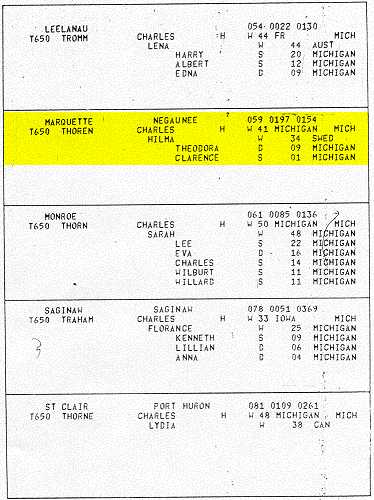
For many years researchers worked without indexes to most of the censuses. Slowly, over the years, indexing was completed for the earlier census records. Of course these indexes were published in books, not on any worldwide internet! The government provided a "soundex" index for some of the censuses 1880 and later, which is available on film. Now there are online and CD indexes to the censuses. So the book indexes and soundexes are unnecessary, right? No! the online census indexes are fabulous, but they contain errors and problems. Sometimes the book index or soundex is just what you need to find your ancestor in the census. Sometimes all of them will fail and you will have to go through the census page by page, hoping you can find the family in the area where you think they should be. Book indexes can be found at major genealogy libraries and are quite straightforward to use, although you have to watch for indexing problems. Using the soundex can be trickier, although again technology has come to our rescue and there are online aids. If you are going to use any post 1870 census records--and unless you and all your U.S. ancestors died prior to 1880 those records are essential-- there will be a point at which you have to understand the soundex indexing system.
"How-to" guides to using census records
Books
Several books are available, either for purchase or at your local library and genealogy magazines contain a plethora of articles written on the subject. Below, I've named just a few and offer information to help you find them. Note: these books were written prior to the explosion of census data on the web and contain information that genealogists needed prior to online availability and search capabilities.
On the web...
And, as always... for more link's see Cyndi's List. She devotes a whole section of her U.S. Census page to links to Census How-To information
back to top
MORE LINKS...
Cyndi's List: US Census Records |